Month-by-month sleep guide
12 Month Old Wake Windows
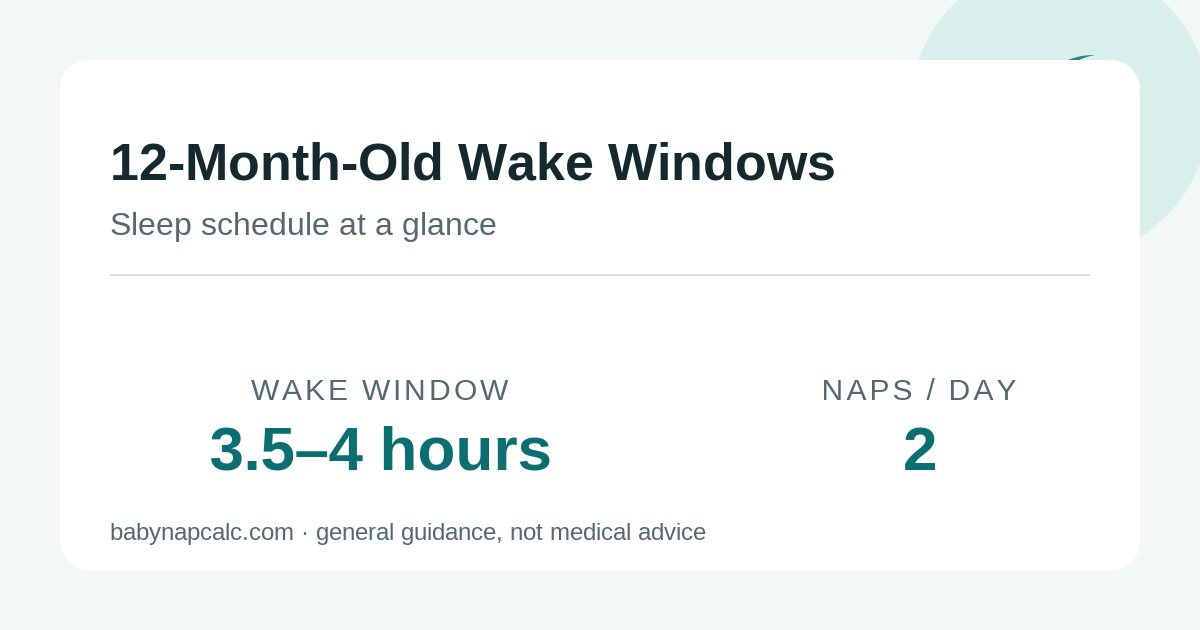
- ⏰ Wake window: 3.5–4 hours
- 🍼 Naps per day: 2
- 🌙 Bedtime: 9:15 PM
- 😴 Total sleep: 12–14 hours
Reviewed by the BabyNapCalc Editorial Team — our content is reviewed for accuracy against pediatric sleep guidance (AAP/NSF). This is general information, not medical advice.
Twelve months — happy first birthday! Your baby is walking (or about to), “talking” in long streams of jargon, and running a steady 2-nap schedule on wake windows of 3.5–4 hours. Total sleep is 12–14 hours. The headline this month: a possible 12-month sleep regression, driven by walking and birthday excitement, plus the first real questions about the eventual move to one nap.
12-month-old sleep at a glance
Typical ranges for 12 months — every baby is different, so treat these as a starting point.
3.5–4 h
Between sleep periods
Full toddler-style windows
2
2 naps
One nap comes later
12–14 h
Naps + night combined
Typical for this age
Sample 12-month-old schedule
An example day with a 7:00 AM wake, built from this month’s midpoint wake windows. Use the mini calculator above with your real wake time.
10:45 AM – 12:15 PM
Nap 1
About 90 minutes
4:00 PM – 5:30 PM
Nap 2
About 90 minutes
9:15 PM
Bedtime
End of the day
The first birthday and the 12-month regression
Twelve months is a milestone in every sense: first steps, first words (or word-like jargon), first birthday — and a sleep schedule that mostly runs itself. Wake windows of 3.5–4 hours, two naps, and 12–14 hours of total sleep. The one watch-out: a 1–2 week sleep regression that often arrives with the walking breakthrough.
Wake windows of 3.5–4 hours
Four hours of awake time is the full toddler-style window, and it structures the day beautifully: up at 7, nap around 10:30, nap around 3, bed around 7:30–8. These long windows mean missed naps hit hard — a skipped nap plus an 11-hour day is a recipe for a rough bedtime. When the schedule wobbles (and around the birthday, it will), the toddler bedtime calculator can help you re-anchor the evening.
Two naps through the first birthday
Hold the 2-nap schedule through 12 months and beyond — the transition to one nap typically lands between 12 and 18 months, and 12 months is the earliest edge, not the average. Signs of genuine readiness: consistently refusing one nap for 2+ weeks despite good timing, or bedtime pushing unmanageably late. Birthday-week nap refusals don't count — that's excitement and disruption, not readiness. The nap calculator can map either schedule while you watch and wait.
The 12-month sleep regression
Learning to walk is a neurological earthquake, and it commonly brings 1–2 weeks of nap refusals, night wakings, and crib-standing practice sessions around the first birthday. Separation anxiety often surges at the same time. The treatment is gloriously boring: same wake time, same nap times, same bedtime, calm brief responses. Most babies come through it in under two weeks — and then walk straight into your heart down the hallway.
Looking ahead: the one-nap transition
Sometime in the next few months, one nap will start getting refused regularly, and the 2-to-1 transition will begin in earnest. When it does, the move is gradual: push the single nap toward midday (11:30–12), cap it around 2–2.5 hours, and use an early bedtime (6–6:30 PM) for months while the long day settles. Our wake windows by age guide covers the toddler windows ahead. For what's next month, see the 13-month-old sleep schedule. Enjoy the birthday — the sleep gets simpler from here.
Signs your 12-month-old’s wake windows need adjusting
Wake windows of 3.5–4 hours with 2 naps a day suit most 12-month-olds, but the clock is only half the story — your baby’s sleepy cues are the other half. Early cues like yawning, quieter play, and a glazed stare mean the window is closing; fussiness, eye rubbing, and arching are late cues that usually mean your baby is already overtired. An overtired baby’s body releases stress hormones that make falling asleep harder, so aim to start the wind-down before the late cues appear.
Two patterns tell you the timing is off. If naps are consistently short, bedtime turns into a battle, or your baby wakes raring to go at 5 a.m., the windows may be too short and your baby is undertired. If your baby fights naps they used to take happily, try stretching each window by 10–15 minutes for a few days. While you experiment, keep the bedtime routine exactly the same — same bath, book, and bed steps — and keep the room dark with steady white noise. That way you can tell whether the timing changed the outcome, not the environment.
The 12-month sleep regression — standing, cruising, first steps, and separation anxiety — can briefly undo good sleep. Hold windows steady for two weeks before deciding anything needs to change.
12-month-old sleep questions, answered
Quick answers to the questions parents ask most about sleep at 12 months.
What is the 12-month sleep regression?
A 1–2 week disruption around the first birthday, driven by learning to walk plus a surge in separation anxiety. Nap refusals and night wakings are typical; consistency resolves it fastest.
What are the wake windows for a 12-month-old?
3.5–4 hours, with the longest window before bedtime.
When should a 12-month-old drop to one nap?
Most transition between 12 and 18 months. At 12 months, only drop if one nap is refused for 2+ weeks despite good timing — birthday-week refusals don't count.
How much sleep does a 1-year-old need?
About 12–14 hours in 24 hours: roughly 10–11 at night plus 2.5–3.5 hours across 2 naps.
This page is a planning guide based on general pediatric sleep guidance, not medical advice. Every baby is different — talk to your pediatrician with concerns about your baby’s sleep.