Month-by-month sleep guide
21 Month Old Wake Windows
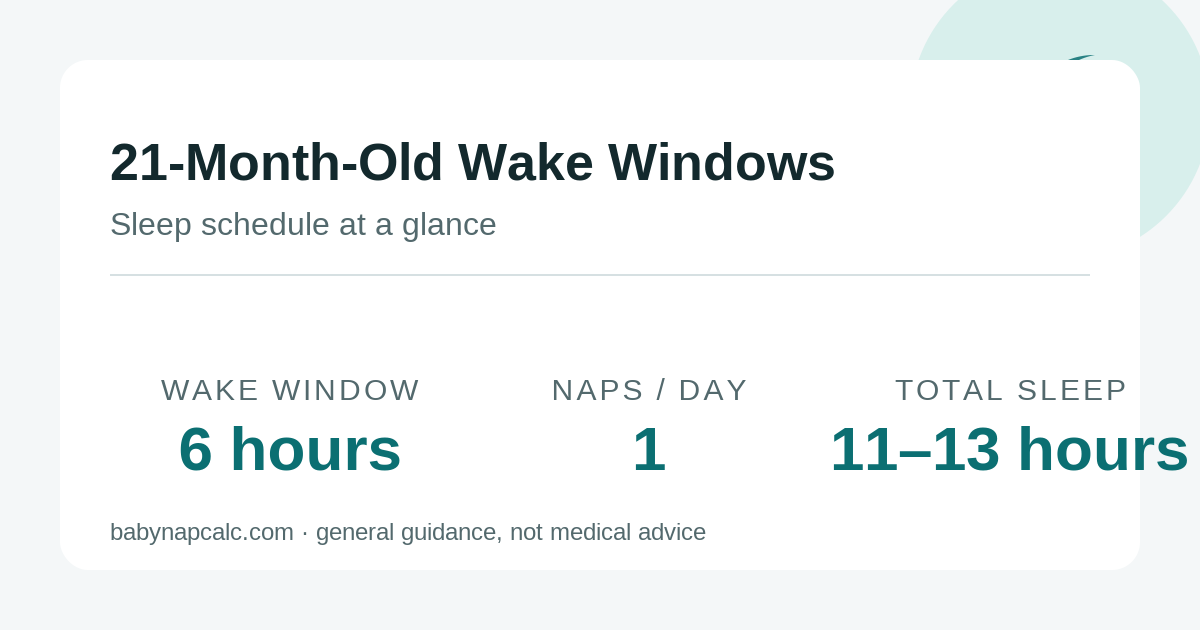
- ⏰ Wake window: 6 hours
- 🍼 Naps per day: 1
- 🌙 Bedtime: 8:30 PM
- 😴 Total sleep: 11–13 hours
Reviewed by the BabyNapCalc Editorial Team — our content is reviewed for accuracy against pediatric sleep guidance (AAP/NSF). This is general information, not medical advice.
Kicking balls and following two-step instructions — the 21-month-old sleep schedule with steady 6-hour wake windows and one reliable nap.
21-month-old sleep at a glance
Typical ranges for 21 months — every toddler is different, so treat these as a starting point.
6 h
Between sleep periods
Typical at 21 months
1
1 nap
Rest of sleep at night
11–13 h
Naps + night combined
Typical for this age
Sample 21-month-old schedule
An example day with a 7:00 AM wake, built from this month’s wake windows. Use the mini calculator above with your real wake time.
1:00 PM – 2:30 PM
Nap 1
About 90 minutes
8:30 PM
Bedtime
End of the day
Sleep at 21 months
Twenty-one months is a sweet spot: the nap transition is a distant memory, wake windows hold steady at 6 hours, and total sleep runs 11–13 hours per day on one nap. Your toddler is kicking a ball, following two-step instructions (“pick up the toy and bring it here”), and stringing words together with growing confidence. Predictable days make for predictable nights.
Wake windows hold at 6 hours
The rhythm is beautifully simple now: 6 hours awake, nap, 6 hours awake, bed. For a 7 AM wake, that means nap around 1 PM and bedtime around 8 PM (after a 1.5–2 hour nap ending ~3 PM, plus 6 hours = ~9 PM — adjust to your nap length; shorter naps mean earlier bedtimes). If your toddler's nap runs long, bedtime naturally lands later; if it's short, bring bedtime forward. The windows matter more than the clock times.
Protecting the midday nap
At 21 months the nap is doing heavy lifting for mood, learning, and night sleep — guard its timing. The most common schedule-wrecker at this age is a nap that slides later and later because mornings are so fun. Anchor lunch before the nap and keep the pre-nap routine short and consistent. A nap starting between 12:30 and 1:30 PM protects an evening bedtime that the whole family can live with.
Milestones: coordination and comprehension
Ball-kicking, climbing with confidence, and genuinely following two-step directions show how far coordination and comprehension have come. Toddlers this age also start testing boundaries at bedtime with creative stall tactics — meet them with a calm, unchanging routine. One useful trick: build your toddler's favorite stall (one more song, one more hug) into the routine itself, so there's nothing left to negotiate for. The 22-month schedule keeps the same 6-hour rhythm as vocabulary keeps exploding.
Signs your 21-month-old’s wake windows need adjusting
Wake windows of 6 hours with 1 naps a day suit most 21-month-olds, but the clock is only half the story — your baby’s sleepy cues are the other half. Early cues like yawning, quieter play, and a glazed stare mean the window is closing; fussiness, eye rubbing, and arching are late cues that usually mean your baby is already overtired. An overtired baby’s body releases stress hormones that make falling asleep harder, so aim to start the wind-down before the late cues appear.
Two patterns tell you the timing is off. If naps are consistently short, bedtime turns into a battle, or your baby wakes raring to go at 5 a.m., the windows may be too short and your baby is undertired. If your baby fights naps they used to take happily, try stretching each window by 10–15 minutes for a few days. While you experiment, keep the bedtime routine exactly the same — same bath, book, and bed steps — and keep the room dark with steady white noise. That way you can tell whether the timing changed the outcome, not the environment.
Twenty-one months: if bedtime starts drifting later and mornings stay fixed, the nap may be running long. Capping it protects the 11–13 hours of total sleep most toddlers need.
21-month-old sleep questions, answered
Quick answers to the questions parents ask most about sleep at 21 months.
How many hours should a 21-month-old sleep?
11–13 hours total per 24 hours — typically about 10–11 hours at night plus a 1.5–2.5 hour midday nap.
What is a good schedule for a 21-month-old?
Wake 7 AM, nap 1–3 PM, bedtime 8 PM is the classic. Shift the whole day earlier or later to match your family's natural wake time — the 6-hour windows are what matter.
My 21-month-old takes forever to fall asleep at nap time. Why?
Usually the morning wake window is too short. Make sure a full 6 hours (sometimes 6.25) pass between wake-up and nap time before assuming the nap is in trouble.
Should the nap be capped at 21 months?
Only if it's pushing bedtime unreasonably late. Most 21-month-olds can nap 2+ hours and still sleep well at night, as long as bedtime stays consistent. Watch total sleep across the week rather than micromanaging any single day.
This page is a planning guide based on general pediatric sleep guidance, not medical advice. Every toddler is different — talk to your pediatrician with concerns about your child’s sleep.