Month-by-month sleep guide
7 Month Old Wake Windows
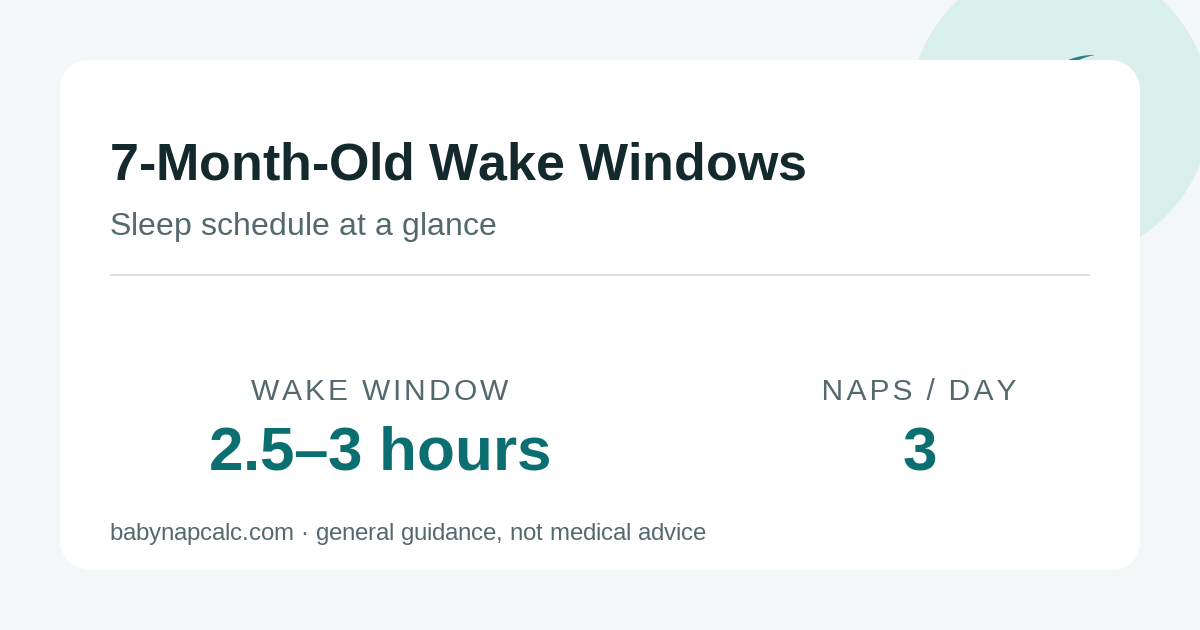
- ⏰ Wake window: 2.5–3 hours
- 🍼 Naps per day: 3
- 🌙 Bedtime: 7:00–8:00 PM
- 😴 Total sleep: 12–15 hours
Reviewed by the BabyNapCalc Editorial Team — our content is reviewed for accuracy against pediatric sleep guidance (AAP/NSF). This is general information, not medical advice.
Seven months is the age of motion — scooting, army crawling, and endless consonant babbling (“da-da-da” on repeat). Wake windows reach 2.5–3 hours, and most babies are still on 3 naps, though the third is increasingly a short catnap whose only job is getting everyone to bedtime intact. Total sleep holds at 12–15 hours.
7-month-old sleep at a glance
Typical ranges for 7 months — every baby is different, so treat these as a starting point.
2.5–3 h
Between sleep periods
Pre-bed window is longest
3
3 naps
Last one is a catnap
12–15 h
Naps + night combined
Typical for this age
Sample 7-month-old schedule
An example day with a 7:00 AM wake, built from this month’s midpoint wake windows. Use the mini calculator above with your real wake time.
9:45 AM – 11:15 AM
Nap 1
About 90 minutes
2:00 PM – 3:30 PM
Nap 2
About 90 minutes
5:30 PM – 6:00 PM
Nap 3
Short catnap, 30 minutes
7:45 PM
Bedtime
End of the day
Motion, babbling, and the shrinking third nap
Seven months packs a lot into the day: a baby who can get themselves across the room, wake windows of 2.5–3 hours, and a 3-nap structure that's starting to creak as windows lengthen. Total sleep stays at 12–15 hours — roughly 10–11 at night plus 3–4 across naps.
Wake windows of 2.5–3 hours
Nearly three hours of happy awake time means the day now has real shape: long play sessions, proper outings, and naps you can almost set your watch by. The pre-bedtime window is usually the longest of the day. These longer windows are also why the third nap gets squeezed — there simply isn't room for three full naps plus a reasonable bedtime anymore, which is exactly why that last nap becomes a catnap.
Three naps, one of them tiny
The classic 7-month pattern: a good morning nap, a long midday nap, and a 30–45 minute late-afternoon catnap around 4–5 PM, with bedtime near 7–7:30. If the catnap runs long or starts too late, bedtime drifts toward 8:30–9 PM and mornings get grumpy. Wake the baby from the catnap without guilt — protecting bedtime matters more than finishing the nap. The nap calculator can show how the day stacks up from your wake time.
Milestone mania at midnight
Seven-month-olds are obsessed with their new powers: scooting across the room, rocking on hands and knees, pulling to knees in the crib, and babbling in full sentences of nonsense. All of it gets rehearsed during light sleep, so expect some midnight practice sessions. The remedy is daytime opportunity: tons of floor time, safe cruising stations, and narrated play. Skills practiced hard by day are practiced less by night — usually within a week or two of the breakthrough.
Babbling and connection
The consonant babbling of this month (“ma-ma”, “da-da”, “ba-ba”) is language practice, and responsive back-and-forth chatter during the day genuinely supports development. It's also a great wind-down tool: a calm, low-energy babble-back session can be part of the bedtime routine. Sleep-wise, hold the line on the 3-nap structure a while longer — the 2-nap transition usually waits until 8–9 months. The baby bedtime calculator keeps bedtime anchored. Next: the 8-month-old sleep schedule.
Signs your 7-month-old’s wake windows need adjusting
Wake windows of 2.5–3 hours with 3 naps a day suit most 7-month-olds, but the clock is only half the story — your baby’s sleepy cues are the other half. Early cues like yawning, quieter play, and a glazed stare mean the window is closing; fussiness, eye rubbing, and arching are late cues that usually mean your baby is already overtired. An overtired baby’s body releases stress hormones that make falling asleep harder, so aim to start the wind-down before the late cues appear.
Two patterns tell you the timing is off. If naps are consistently short, bedtime turns into a battle, or your baby wakes raring to go at 5 a.m., the windows may be too short and your baby is undertired. If your baby fights naps they used to take happily, try stretching each window by 10–15 minutes for a few days. While you experiment, keep the bedtime routine exactly the same — same bath, book, and bed steps — and keep the room dark with steady white noise. That way you can tell whether the timing changed the outcome, not the environment.
Seven months can bring separation anxiety and lots of practice sitting and babbling — exciting milestones that sometimes spill into nights. Extra daytime practice plus consistent timing usually settles it.
7-month-old sleep questions, answered
Quick answers to the questions parents ask most about sleep at 7 months.
Why does my 7-month-old keep standing up in the crib?
New motor skills get practiced during light sleep. Give lots of daytime practice, keep night responses boring, and make sure the mattress is lowered. The phase usually passes within a couple of weeks.
Should I cap my 7-month-old's last nap?
Yes — 30–45 minutes is plenty. A long late nap pushes bedtime late and can cause early-morning waking.
What are the wake windows for a 7-month-old?
2.5–3 hours, with the longest window before bed.
How much total sleep does a 7-month-old need?
About 12–15 hours in 24 hours: roughly 10–11 at night plus 3–4 hours across 3 naps.
This page is a planning guide based on general pediatric sleep guidance, not medical advice. Every baby is different — talk to your pediatrician with concerns about your baby’s sleep.